In mathematics, the Fibonomial coefficients or Fibonacci-binomial coefficients are defined as

where n and k are non-negative integers, 0 ≤ k ≤ n, Fj is the j-th Fibonacci number and n!F is the nth Fibonorial, i.e.

where 0!F, being the empty product, evaluates to 1.
Special values
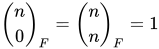
The Fibonomial coefficients are all integers. Some special values are:




Fibonomial triangle
The Fibonomial coefficients (sequence A010048 in the OEIS) are similar to binomial coefficients and can be displayed in a triangle similar to Pascal's triangle. The first eight rows are shown below.
|
|
|
|
|
|
|
|
|
|
|
|
|
|
|
|
|
|
|
 |
|
1 |
|
 |
|
1 |
1 |
|
 |
|
1 |
1 |
1 |
|
 |
|
1 |
2 |
2 |
1 |
|
 |
|
1 |
3 |
6 |
3 |
1 |
|
 |
|
1 |
5 |
15 |
15 |
5 |
1 |
|
 |
|
1 |
8 |
40 |
60 |
40 |
8 |
1 |
|
 |
|
1 |
13 |
104 |
260 |
260 |
104 |
13 |
1
|
The recurrence relation

implies that the Fibonomial coefficients are always integers.
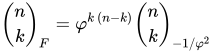
The fibonomial coefficients can be expressed in terms of the Gaussian binomial coefficients and the golden ratio  :
:
Applications
Dov Jarden proved that the Fibonomials appear as coefficients of an equation involving powers of consecutive Fibonacci numbers, namely Jarden proved that given any generalized Fibonacci sequence  , that is, a sequence that satisfies
  for every
  then
then
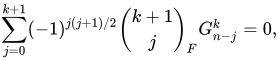
for every integer  , and every nonnegative integer
  .
.
References
- Benjamin, Arthur T.; Plott, Sean S., A combinatorial approach to Fibonomial coefficients (PDF), Dept. of Mathematics, Harvey Mudd College, Claremont, CA 91711, archived from the original (PDF) on 2013-02-15, retrieved 2009-04-04
{{citation}}: CS1 maint: location (link)
- Ewa Krot, An introduction to finite fibonomial calculus, Institute of Computer Science, Bia lystok University, Poland.
- Weisstein, Eric W. "Fibonomial Coefficient". MathWorld.
- Dov Jarden, Recurring Sequences (second edition 1966), pages 30–33.